Single tooth implants
Single tooth implants in Crewe
A single dental implant replaces one missing tooth with an implant placed in the jawbone and a custom crown fitted on top. Unlike a conventional bridge, it usually does not require the healthy teeth beside the gap to be prepared for support.
Your first step is a £200 implant consultation, including a CT scan. Your implant dentist will assess your jawbone, gums and general health, then explain the treatment options, expected timeline and individual cost.

What it is
What a single tooth implant is made of
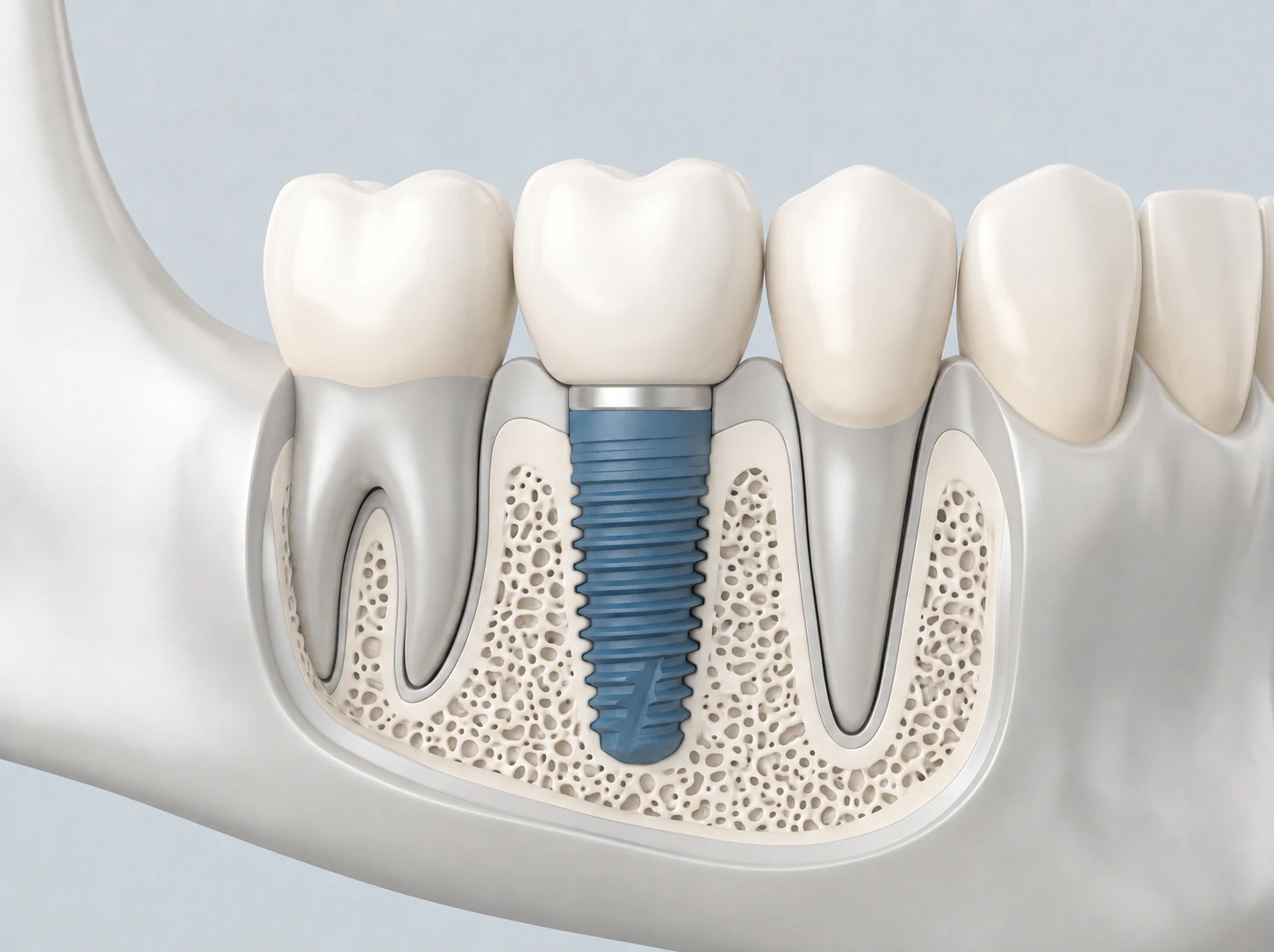
A single implant replaces the root of one missing tooth and supports a crown above it. The implant, connector and crown are usually completed in planned stages, allowing time for healing between the appropriate steps.
-
The implant
A small post, usually made from titanium, placed in the jawbone where the root of the missing tooth used to be. It is allowed time to integrate with the surrounding bone according to your individual treatment plan.
-
The abutment
A connector fitted to the implant once it is clinically ready. It sits at gum level and holds the crown in position.
-
The crown
The visible replacement tooth, made to fit the space and shaded to sit alongside your own teeth. On a single implant the crown is included in the fee quoted.
A single implant can replace a tooth without using the neighbouring teeth for support. A conventional bridge usually requires one or more supporting teeth to be prepared. With an implant crown, healthy teeth beside the gap usually do not need to be prepared for this purpose.
Treatment options
Ways one missing tooth can be replaced
An implant is one of several options for a single gap. Which is appropriate depends on where the tooth is, the condition of the neighbouring teeth, your bone and gums, and what you want treatment to achieve.
-
Option one
A single implant
An implant placed in the jawbone supports a crown in the gap. The healthy teeth beside it usually do not need to be prepared to support the replacement.
- Fixed in place and cleaned with daily brushing and interdental cleaning
- Usually completed in planned stages over several months
- Planned following an assessment of your bone, gums and general health
-
Option two
A bridge
A fixed replacement supported by one or more neighbouring teeth. Conventional bridges usually require the supporting teeth to be prepared, while adhesive bridges may require little or no preparation.
- Fixed in place and does not require implant surgery
- The preparation required depends on the type of bridge
- Suitability depends partly on the condition of the supporting teeth
-
Option three
A partial denture
A removable plate carrying the replacement tooth, taken out for cleaning.
- Removable and does not require implant placement
- Can replace more than one tooth at a time
- Designed to be removed for daily cleaning
-
Option four
Leaving the gap
In some cases, leaving a gap and monitoring it can be a reasonable option. Your dentist will consider its position, your bite and the health of the surrounding teeth.
- Avoids restorative treatment at that stage
- Your dentist will explain any possible effect on your bite and nearby teeth
- The area can be reviewed during routine dental appointments
The most suitable choice is based on your individual needs. Your dentist will explain which options apply after examining the gap, your bite and the surrounding teeth. Where treatment is proposed, you will receive the relevant costs before deciding. Current starting prices are listed in our private fee guide; dental bridges are priced per unit.
The process
What single implant treatment involves
Treatment is usually completed in planned stages over several months. The final crown is normally fitted once the implant has integrated with the surrounding bone, although timings vary between patients.
-
Assessment and CT scan
Your teeth, gums and bite are examined, your medical history is reviewed and a CT scan assesses the bone available at the site. Before treatment begins, you receive a written plan setting out the proposed treatment, expected timeline and cost.
-
Preparing the site, if needed
Some people need treatment first, such as gum treatment, removing a tooth that cannot be kept, or building up bone where there is not enough. Anything required is explained and quoted in advance.
-
Placing the implant
The area is numbed with local anaesthetic and the implant is placed in the jawbone. Stitches may be used while the gum heals. Sedation may be available where clinically appropriate and can be discussed during your assessment.
-
Healing
The implant is allowed time to integrate with the surrounding bone. Healing commonly takes several months. Where appropriate, your dentist will discuss temporary tooth options for a visible gap.
-
Fitting the crown
When the implant is clinically ready, impressions or a scan are taken and the crown is made to fit the space. The abutment and crown are then fitted.
-
Review and ongoing care
The implant is reviewed after fitting and monitored at your routine appointments. Effective daily cleaning, healthy gums and regular professional maintenance all help protect the implant and crown over the long term.
Timings are given for your own case at the planning stage. Healing varies with the site, the bone and your general health, so your dentist will set out an expected timeline once the assessment is complete rather than beforehand.
Planning your treatment
How we assess and plan a single tooth implant
Your implant consultation brings together the health of your mouth, the bone at the site, your medical history and your treatment goals. This allows your implant dentist to plan an approach suited to your individual circumstances.
A single implant may suit you if
- You are missing one tooth and want a fixed replacement
- The teeth beside the gap are healthy and you would rather not prepare them for a conventional bridge
- A tooth needs removing and you want to discuss replacement before it comes out
- You have worn a partial denture for one tooth and would prefer something fixed
What your assessment covers
- The health of your teeth and gums. Decay, gum disease or infection is usually treated first
- The bone available at the site, and the position of nearby structures, using a CT scan
- Your general health and any medication, since both can affect planning and healing
- Your smoking history, because it can influence healing and the long-term health of an implant
Your assessment is designed to give you a clear, personalised recommendation. If additional bone support would improve the proposed treatment, grafting may be included in the plan and quoted separately. Where relevant, your dentist can also explain alternatives such as a bridge or partial denture. Any proposed treatment and its expected cost will be explained before you decide whether to proceed.
What it costs
How much does a single tooth implant cost in Crewe?
The published starting fee of £2,500 includes a single implant and its crown. If preparatory treatment is required, it is quoted separately so you can see what is included in your individual plan.
Private fees
| Initial implant consultation, including CT scan | £200 |
|---|---|
| Single implant with crown | from £2,500 |
| Tooth extraction, where required | from £195 |
| Dental bridge, per unit, as an alternative | from £650 |
| Partial denture, as an alternative | from £750 |
Worth knowing
What may be quoted on top
Depending on your assessment, the treatment plan may include an extraction, gum care or bone grafting before or alongside implant placement. Any additional procedure will be explained and quoted separately before treatment begins.
See the fee guideSpreading the cost
Finance options
Eligible patients may be able to spread treatment costs of £350 or more through finance arranged with Chrysalis Finance. Finance is subject to status, eligibility and the applicable terms.
How finance worksClear costs before treatment. After your assessment, you will receive a written treatment plan or estimate, as appropriate, explaining the implant, crown, any preparatory stages and likely cost before you decide whether to proceed. If the proposed treatment or cost changes, we will discuss it with you before proceeding.
Common questions
Single tooth implant questions
What people ask most often before booking an assessment. If yours is not here, call the practice and ask.
How much does one dental implant cost?
A single implant with a crown starts from £2,500, subject to assessment. The initial consultation including a CT scan is £200. Preparatory treatment such as building up bone is quoted separately. See our private fee guide.
How long does it take?
Single implant treatment is usually completed in planned stages over several months. The final crown is normally fitted after the implant has integrated with the surrounding bone. Your individual stages and expected timeline will be explained during treatment planning.
Is having an implant placed painful?
Local anaesthetic is used to numb the area before implant placement. You may feel pressure or movement during the procedure, and some soreness, swelling or bruising can occur afterwards while the area heals. Sedation may also be available where clinically appropriate and can be discussed during your assessment.
How long will it last?
A dental implant is designed as a long-term tooth-replacement option. Its longevity is influenced by the health of the surrounding gum and bone, effective daily cleaning, smoking, general health and regular professional maintenance. The implant and crown will be monitored at your routine appointments.
Will I need a bone graft?
Your examination and CT scan will show how much bone is available at the implant site. If additional bone support is needed, your implant dentist will explain the proposed grafting procedure, how it affects the timeline and the separate cost before treatment begins.
Will I have a temporary tooth while the implant heals?
Where the gap is visible, your dentist will discuss whether a temporary tooth is appropriate while the implant heals. The available option depends on the position of the gap, the surrounding teeth and your individual treatment plan.
Book your single tooth implant consultation
Your £200 consultation includes an examination and CT scan to assess the gap, your jawbone and the surrounding teeth. Your implant dentist will explain the appropriate options and next steps. If treatment is proposed, you will receive a written treatment plan or estimate setting out the expected stages and likely cost before you decide whether to proceed.