Composite bonding
Composite bonding in Crewe
Tooth-coloured composite, shaped onto your own teeth by hand and set hard in the chair. It is used to rebuild a chipped edge, close a small gap or even up teeth that have worn down.
Usually one appointment, and usually nothing is drilled away. That is the real appeal of it. The composite sits on top of the tooth you already have, so if you decide against it later you have not burnt any bridges. We quote the cost after an assessment, because no two of these need the same amount of work.
What it is for
Small changes, done in the chair
Bonding suits jobs where a bit of tooth is missing or the shape is not quite right. It is less good at changing the colour of a whole smile.
-
A chipped corner
The most common reason people come in for it. A corner knocked off a front tooth can be rebuilt the same day.
-
Edges worn flat
Years of grinding leave front teeth short and squared off. Adding back the lost height brings the shape round again.
-
A gap you dislike
A small space at the front can be narrowed by widening the teeth on either side of it.
-
One tooth out of step
A tooth that is a slightly odd shape, or sits a fraction behind its neighbour, can be brought into line.
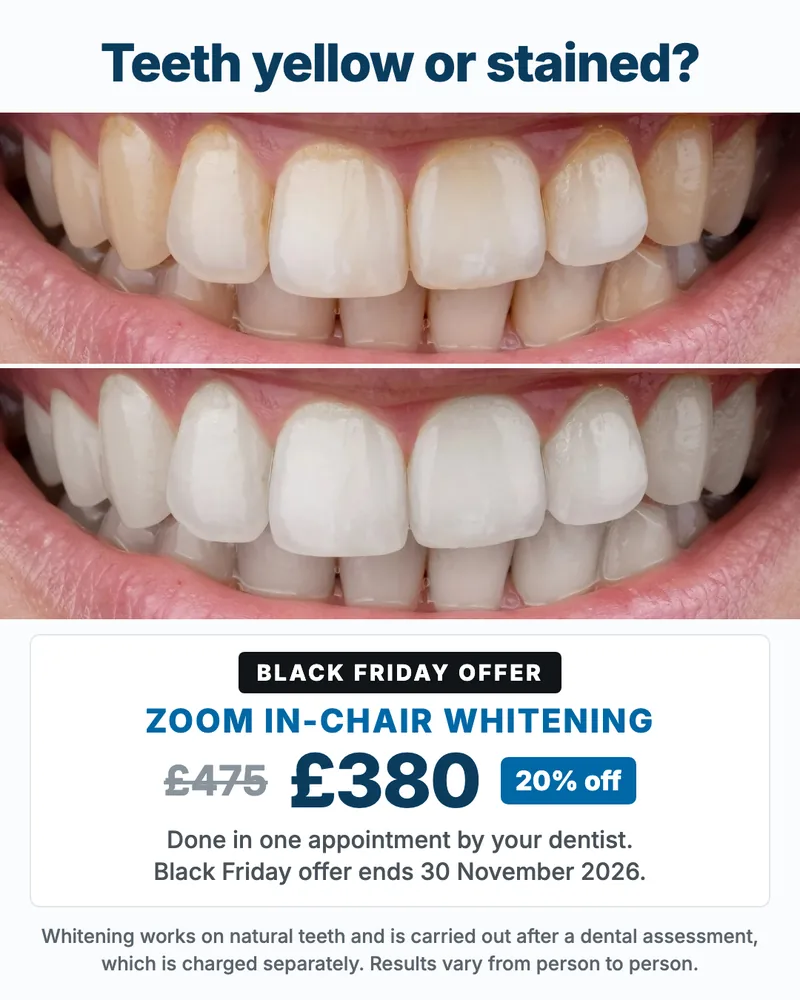
If the colour is the problem, bonding is the wrong tool. Composite does not lighten a tooth, it covers it, and covering every front tooth in composite to change the shade rarely ages well. Whitening is usually the better first step, and if the staining will not shift, porcelain veneers hold their colour longer than composite does.
What happens
Usually one appointment
Nothing goes off to a laboratory, so there is no waiting and no temporary stage. You leave with the finished result.
-
Agreeing the shape
Your dentist looks at what is bothering you and says what can be done with composite. This is also where you find out if bonding is not the right answer for your case.
-
Matching the shade
Composite comes in a range of shades. Your dentist picks one against your own teeth, in daylight where possible, because the match matters more than the brightness.
-
Building it up
The surface is lightly prepared so the composite grips, then it goes on in layers and a light sets each one hard. This is the part that takes the time.
-
Shaping and polishing
Your dentist trims the shape, checks how you bite together, and polishes it until it catches the light like enamel rather than looking flat.
No injection in many cases. If nothing is being drilled and the tooth is not sensitive, bonding can often be done without local anaesthetic. Say if you would rather be numb anyway, because plenty of people would.
Living with it
What happens in a few years
Composite is a good material but it is not enamel, and anyone telling you otherwise is selling something.
It picks up colour. Tea, coffee, red wine and smoking all stain composite faster than they stain teeth, and the joins at the edges tend to go first. A polish at a hygiene appointment lifts a good deal of that.
It can chip. Biting a fork, opening something with your teeth, or grinding at night will all take a corner off eventually. The upside is that a chip in composite is usually patched in one short appointment rather than remade from scratch.
Neither of these is a reason to avoid it. They are a reason to know what you are buying. Budget for the odd repair rather than expecting to have it done once and forget it.
Making it last
- Keep up your check-ups, so wear is spotted before it becomes a break
- Have it polished at hygiene appointments rather than when it already looks dull
- Cut down on the things that stain, especially in the first couple of days
- Wear a guard at night if you grind, or the composite takes the beating your teeth used to
- Stop using your front teeth as scissors
Common questions
Bonding questions
The things people want settled before they book.
How much does it cost?
It depends on how many teeth are involved and how much work each needs. The price comes after an assessment rather than off a list. That assessment is £99.99 if you are new to the practice, £59.99 if you are already with us.
How long does it last?
Several years is normal, and some people get a good deal longer. It depends mostly on your bite and your habits rather than on the material. Expect to have it polished along the way and patched occasionally.
Will it match my other teeth?
That is the whole skill of it. Your dentist picks the shade against your own teeth before starting. If you are planning to whiten, do that first, because composite will not lighten afterwards.
Does it damage the tooth?
In most cases nothing is drilled away, which is the main thing that separates it from a veneer. The surface is lightly roughened so the composite grips, and that is as far as it goes.
Can it be taken off again?
Generally yes. Because the tooth underneath has not been reshaped, composite can be removed and the tooth left much as it was. That is not true once a tooth has been prepared for a veneer.
Should I have bonding or veneers?
Bonding if you want it done in a day, kept reversible and cheaper. Veneers if you want it to hold its colour for longer and you are certain. Your dentist will say if one of them will not work in your case.
Ask what bonding would do
Bring in the tooth that bothers you. Your dentist will tell you what composite can and cannot do with it, and what it would cost. You get the figure before anything starts, and there is no obligation.