Full mouth dental implants
Full mouth dental implants in Ipswich
If you have lost most or all of your teeth in one jaw, or your denture no longer feels secure, a fixed bridge supported by implants may be an option. These treatments are often called All-on-4 or All-on-6, after the number of implants used to hold the bridge in place.
Your first step is a £250 implant consultation, including a CBCT 3D scan of your jaw. Dr Rohit Patel will tell you whether full mouth implants would work for you, what the alternatives are, and what your own treatment would cost, before anything is decided.
What it is
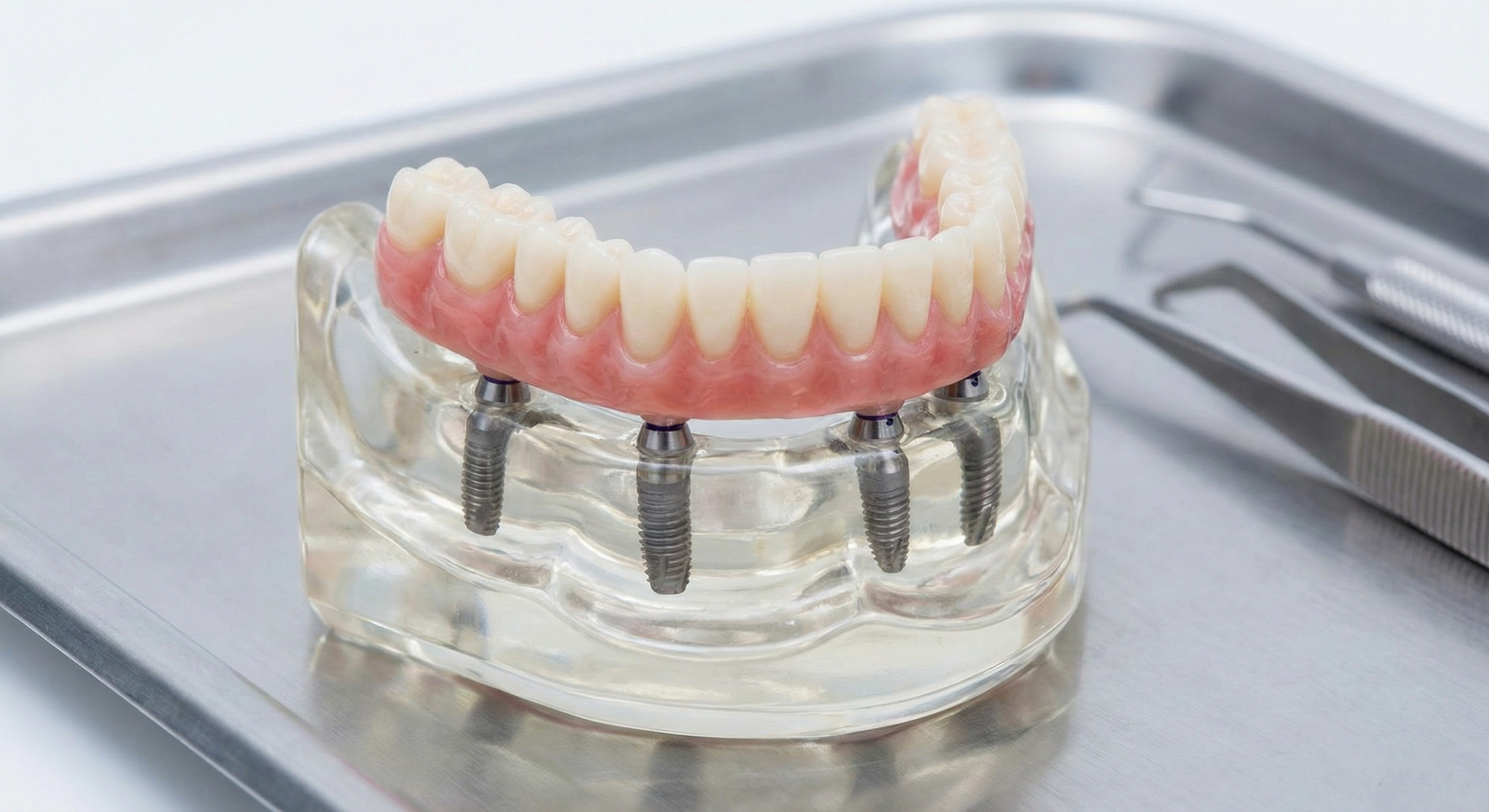
How All-on-4 and All-on-6 support a full arch
A full mouth implant bridge replaces a whole upper or lower arch using a small number of implants rather than one for every tooth. The bridge is fixed in place and is removed only by the dental team, at a maintenance appointment.
-
The implants
Usually four to six small titanium posts placed in the jawbone at planned positions. Some are often angled towards the back of the jaw, which can make better use of the bone that is already there.
-
Integration
Over the following months the bone grows against the implants and holds them firm. This is called osseointegration, and it is what gives the finished bridge its stability.
-
The bridge
One piece carrying a full arch of replacement teeth, made from acrylic or porcelain and fixed onto the implants. It does not rest on your gums and does not need adhesive.
All-on-4 and All-on-6 describe how many implants carry the bridge. All-on-4 uses four implants per arch and suits many standard cases. All-on-6 uses six, and may be advised where more support or a wider spread of load is wanted. Which is appropriate is decided from your scan and examination, not in advance.
Treatment options
Ways a full arch can be replaced
A fixed bridge on implants is one of several ways to replace a whole arch. Which is appropriate depends on the bone you have, the health of your gums, your general health and what you want day to day.
-
Option one
All-on-4 fixed bridge
Four implants per arch carry one fixed bridge. The back implants are usually angled to make use of the bone already present.
- Fixed in place and not removed by you
- Angled placement can sometimes reduce the need for grafting
- Often appropriate in standard full arch cases
-
Option two
All-on-6 fixed bridge
Six implants per arch carry the bridge instead of four, spreading the load across more points of support.
- May be advised where extra support is wanted
- Depends on having enough bone in the right positions
- Not everyone needs six implants
-
Option three
Implant-retained denture
A denture that clips onto a smaller number of implants. You take it out to clean it, but it is held far more firmly than a conventional denture.
- Removable for cleaning, clipped in for the day
- Usually needs fewer implants than a fixed bridge
- May be recommended where a fixed bridge is not appropriate
-
Option four
A conventional denture
A removable denture resting on the gums, without implants. It remains a reasonable option for many people and is the least involved treatment.
- No implant surgery and no healing period
- Lower cost than any implant option
- Held by fit and suction, and may need adhesive
Which option is right is decided after your scan and examination. Dr Rohit Patel will go through what your bone and gums will support, what each option would mean day to day, and what each would cost. Denture prices are listed in our private fee guide, and a full arch implant plan is quoted for your own case.
The process
What full mouth treatment involves
Treatment runs in planned stages, and reaching the final bridge commonly takes around three to six months. Your own timeline depends on how you heal and on any preparatory work, and it is set out for you once the assessment is complete.
-
Assessment and CBCT scan
Your remaining teeth, gums and bite are examined and your medical history is reviewed. A CBCT scan shows how much bone you have and where the nerves and sinuses sit, which is what decides how many implants can be placed and where.
-
Your written plan
You receive a written treatment plan setting out the recommended approach, the stages, the expected timeline and the cost, including any preparatory procedures. You are encouraged to take it away and think about it.
-
Preparing the jaw, if needed
Teeth that cannot be kept are removed, and gum treatment or bone grafting is carried out where the plan calls for it. Anything required is explained and quoted before it goes ahead.
-
Placing the implants
The jaw is numbed with local anaesthetic and the implants are placed at the planned positions. Sedation may be available where clinically appropriate and can be discussed at your assessment.
-
Healing and a temporary bridge
The implants are left to integrate with the bone. Where the case allows it, a temporary fixed bridge can be fitted so you are not without teeth while this happens. Whether that applies to you depends on how firm the implants are at placement.
-
The final bridge and ongoing care
Once the implants are clinically ready, the final bridge is made and fitted. After that it is cleaned daily with the aids you are shown, and checked at regular review and hygiene appointments.
Same day teeth are not a certainty. A temporary fixed bridge on the day of surgery depends on how stable the implants are once placed and on what the scan shows beforehand. Your dentist will tell you at the planning stage whether it is likely in your case, rather than promising it in advance.
Planning your treatment
How we assess a full mouth case
A full arch plan rests on what your jaw can support. The consultation brings together your scan, the health of your mouth, your medical history and what you want from treatment, so the recommendation you get is for your own situation.
Full mouth implants may suit you if
- Your denture moves when you eat or speak, or rubs and causes soreness
- Several teeth in one jaw are failing and are unlikely to be kept
- You want teeth that stay in place rather than something you take out
- You are prepared to clean daily and attend regular reviews, which the treatment depends on
What your assessment covers
- The bone in each jaw, using a CBCT scan, which decides how many implants can be placed and where
- The health of your gums and any remaining teeth. Infection or gum disease is usually treated first
- Your general health and medication, since both affect surgery and healing
- Your smoking history, because it influences healing and long-term implant health
Full mouth implants are not appropriate for everyone. Where the bone, your gum health or your general health makes a fixed bridge unsuitable, Dr Rohit Patel will say so and go through the alternatives, including an implant-retained denture or a conventional one. Moderate bone loss does not always rule implants out, because angled placement can sometimes work with the bone you have, but that is a decision for the scan rather than for a web page.
What it costs
What full mouth implants cost in Ipswich
A full arch plan is priced for your own case rather than from a list, because the number of implants, the bridge material and any preparatory work all change the total. The fees below are the published ones that commonly form part of a plan, so you can see what the pieces cost before you come in.
Published private fees
| Implant consultation, including CBCT scan | £250 |
|---|---|
| Study models and treatment planning | £250–£450 |
| Simple extraction, where required | from £150 |
| Surgical extraction, where required | from £350 |
| Bone graft, simple | £500 |
| Bone graft, complex | £1,800–£2,800 |
| Sinus lift | from £1,800 |
| Ridge preservation | £1,000 |
| Acrylic denture, per arch, as an alternative | from £850 |
| Chrome denture, as an alternative | from £1,000 |
Worth knowing
Why there is no single price
Two people wanting the same result can need very different treatment. How much bone you have decides how many implants can be placed, whether grafting is needed and which bridge is appropriate. Your figure comes from your scan, in writing.
See the fee guideLarger treatment plans
Spreading the cost
Full arch treatment is a significant cost and is usually paid in stages as treatment progresses. Ask our team what payment options are available to you, and we will go through them before you decide whether to go ahead.
Ask our teamYou get the full figure before you commit to anything. After your assessment you receive a written treatment plan setting out the recommended approach, every stage, the expected timeline and the total cost, including any preparatory procedures. Take it away and think about it. If the proposed treatment or the cost changes at any point, we will discuss it with you first.
Common questions
Full mouth implant questions
What people ask most often before booking an assessment. If yours is not here, call the practice and ask.
What is the difference between All-on-4 and All-on-6?
The number of implants carrying the bridge. All-on-4 uses four per arch and is often appropriate in standard cases. All-on-6 uses six, which spreads the load across more points and may be advised where extra support is wanted. Your scan and examination decide which applies, and not everyone needs six.
What does it cost?
A full arch plan is quoted for your own case, because the number of implants, the bridge and any preparatory work all change the total. The consultation including a CBCT scan is £250, and the published fees for grafting, extractions and dentures are in our private fee guide. You receive the full figure in writing after your assessment.
Will all my remaining teeth have to come out?
Only the ones that cannot be kept. If you still have teeth in the jaw being treated, the examination and CBCT scan show which have a future and which do not. Where enough sound teeth remain, your dentist may recommend saving them and replacing only what is missing, rather than clearing the arch.
Can I have teeth fitted on the same day?
In suitable cases a temporary fixed bridge can be fitted on the day the implants are placed, so you are not left without teeth. It depends on how stable the implants are once in and on what the scan showed beforehand, so it is confirmed at the planning stage rather than promised in advance.
How long does the whole treatment take?
Reaching the final bridge commonly takes around three to six months, allowing time for the implants to integrate with the bone. Your own timeline depends on how you heal and on any extractions or grafting needed first, and is set out in your written plan.
Is it painful?
The jaw is numbed with local anaesthetic for the procedure. Soreness and swelling around the implant sites are common afterwards while things settle, and are usually managed with pain relief. Sedation may be available where clinically appropriate and can be discussed at your assessment.
How long will a full arch bridge last?
Full arch implants are designed as a long-term treatment and can work well for many years, but no dental treatment can be guaranteed to last indefinitely. How long yours lasts is influenced by your gum and bone health, daily cleaning, smoking, general health and keeping up regular professional reviews.
Will I still need to clean them?
Yes, and the treatment depends on it. The bridge is cleaned daily with brushing and the cleaning aids you are shown for getting underneath it. Regular hygiene and review appointments monitor the gums and the implants, which is what protects the result over time.
What if I am not suitable for a fixed bridge?
Dr Rohit Patel will tell you so directly and go through what is appropriate instead. That often means an implant-retained denture, which clips onto fewer implants and is taken out to clean, or a conventional denture. Both are explained with their costs so you can compare.
Book your full mouth implant consultation
Your £250 consultation includes an examination and a CBCT scan of your jaw. Dr Rohit Patel will go through what your bone will support, whether All-on-4, All-on-6 or an implant-retained denture is appropriate, and what the alternatives are. If treatment is proposed you receive a written plan with the stages, the timeline and the full cost, to take away and consider.